Back to Articles and Learning
Risk Management8 min read

How ERM Teams Produce Consistent, Board-Ready Risk Reports on a Recurring Cadence

Initia Risk Team
Mar 9, 2026
How ERM Teams Produce Consistent, Board-Ready Risk Reports on a Recurring Cadence

Quick answer

How ERM teams produce consistent board-ready risk reports on a recurring cadence: by treating the pack as the output of a repeatable six-week cycle (week 1 - risk owner updates; weeks 2-3 - consolidation; week 4 - drafting; week 5 - second-line review and challenge; week 6 - submission), with a fixed five-section structure (executive risk summary, movements since last period, KRIs, top-risk deep-dives, actions and remediation), and with structured data feeds from the risk register, RCSA outputs and KRI dashboards rather than ad-hoc data calls.

Source: Initia Risk - this is the operational delivery view. For the governance view of what the pack must contain, see our guide to board-level risk reporting requirements.

Ask most ERM professionals what their biggest operational challenge is, and board reporting comes up quickly. Not because the risks are hard to identify - but because turning a living, messy risk register into a clean, confident, board-ready pack on a recurring basis is genuinely difficult.

Data is stale. Owners haven't updated their risks. The format from last quarter doesn't quite fit the new priorities. Someone senior asks a question in the meeting that should have been anticipated. Sound familiar?

This article sets out how high-performing ERM teams solve this - with a clear structure, a disciplined cadence, and a reporting pack that boards actually find useful.

Scope: this is the operational piece - how to run the pack and the quarterly cycle. For the governance view of what a credible board-level risk report must cover (including regulatory expectations and a fuller component list), read board-level risk reporting: what boards and regulators expect first if you are designing from scratch; then use this article to make delivery repeatable.

What Boards Actually Want From a Risk Report

Before thinking about format, it's worth being clear on what the board is trying to do with risk information. They are not trying to manage individual risks themselves. They are trying to:

  • Understand whether the organisation's overall risk profile is within appetite
  • Identify whether any risks have materially changed or escalated since last period
  • Gain confidence that management is on top of the most significant exposures
  • Make informed decisions on risk appetite, resource allocation, or strategic direction where needed

This means the board doesn't need (or want) a 40-page register dump. They need a well-curated pack that surfaces what matters, provides the right level of context, and doesn't bury the signal in noise.

Key Principle

The board report is not the risk register

The risk register is the working document. The board pack is a curated, narrative-led summary of the most significant risks and movements. Conflating the two is one of the most common reasons board risk reporting fails to land.

The Structure of an Effective Board Risk Pack

A well-structured board risk pack typically contains five components:

1. Executive Risk Summary

A one-page (or one-slide) overview of the organisation's current risk profile. This should include a heat map or top risk list, an overall view of whether the aggregate risk position is within appetite, and a brief narrative on the risk environment - both internal and external factors that are shaping the risk landscape this period.

2. Risk Movements

What has changed since the last board report? Risks that have increased, decreased, or newly emerged. This is the section that creates the sense of a live, managed risk programme rather than a static document. Movement without explanation is as unhelpful as no movement at all - every change should carry a brief rationale.

3. Key Risk Indicators (KRIs)

If your organisation tracks KRIs, the board report is where their status should be summarised. Green, amber, red - and a brief note on any that have moved into amber or red territory. KRIs give the board an early-warning system and demonstrate that risk monitoring is continuous, not just quarterly.

4. Top Risks Deep-Dive

A short section covering the top three to five risks in detail: current rating, risk owner, key controls in place, any open actions, and expected timeline for resolution or review. This gives the board confidence that the highest-priority exposures have active ownership and management behind them.

5. Actions and Remediation Update

A status update on previously agreed actions - particularly any that were raised at the last board meeting. Boards pay attention to whether commitments are followed through. Showing progress (or clearly explaining slippage) builds credibility and demonstrates that the risk function is accountable.

Real reporting views from Initia Risk Slide Builder - scroll to explore
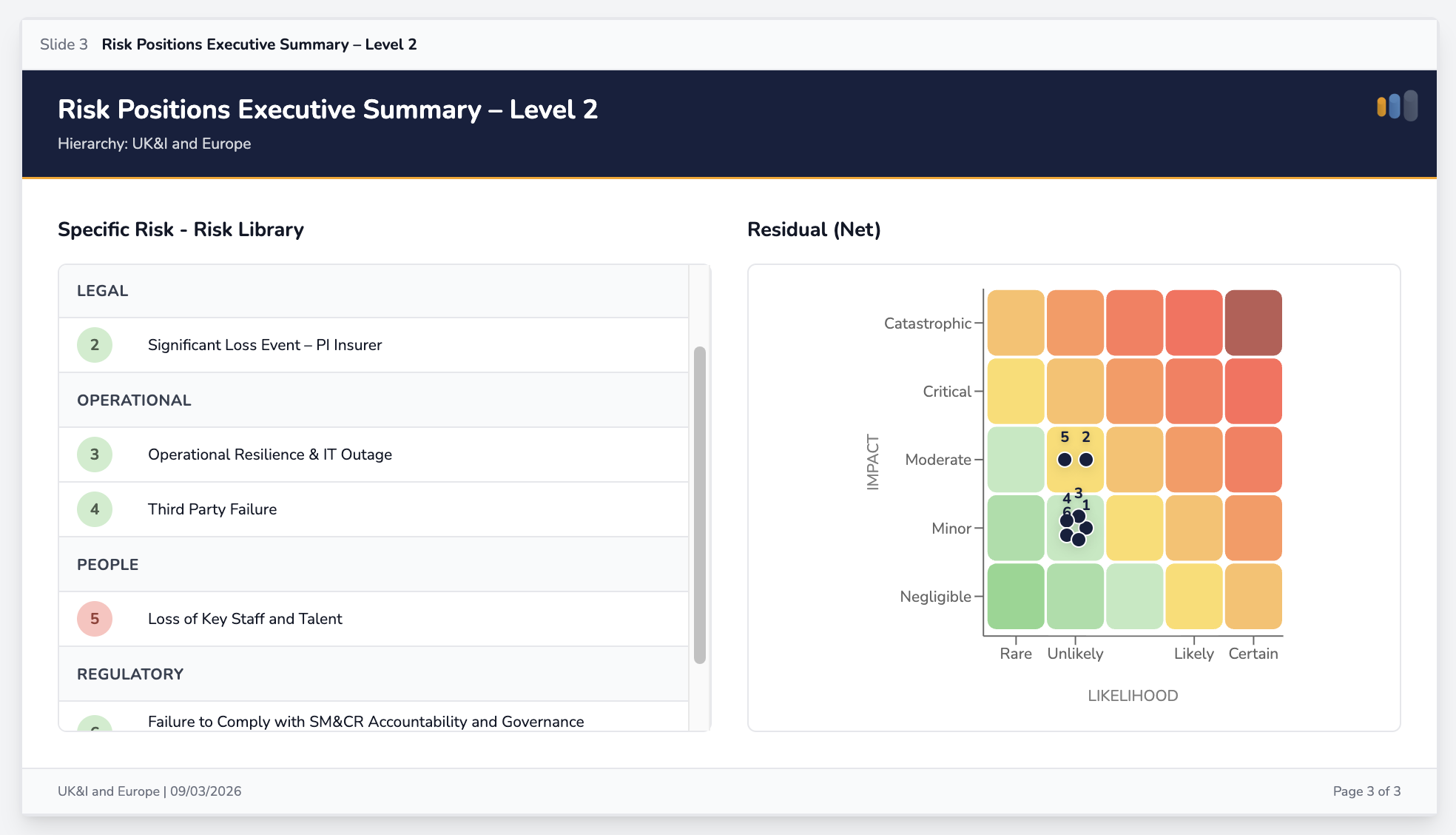
Initia Risk Slide Builder - risk positions executive summary (real screenshot)
Risk positions executive summary
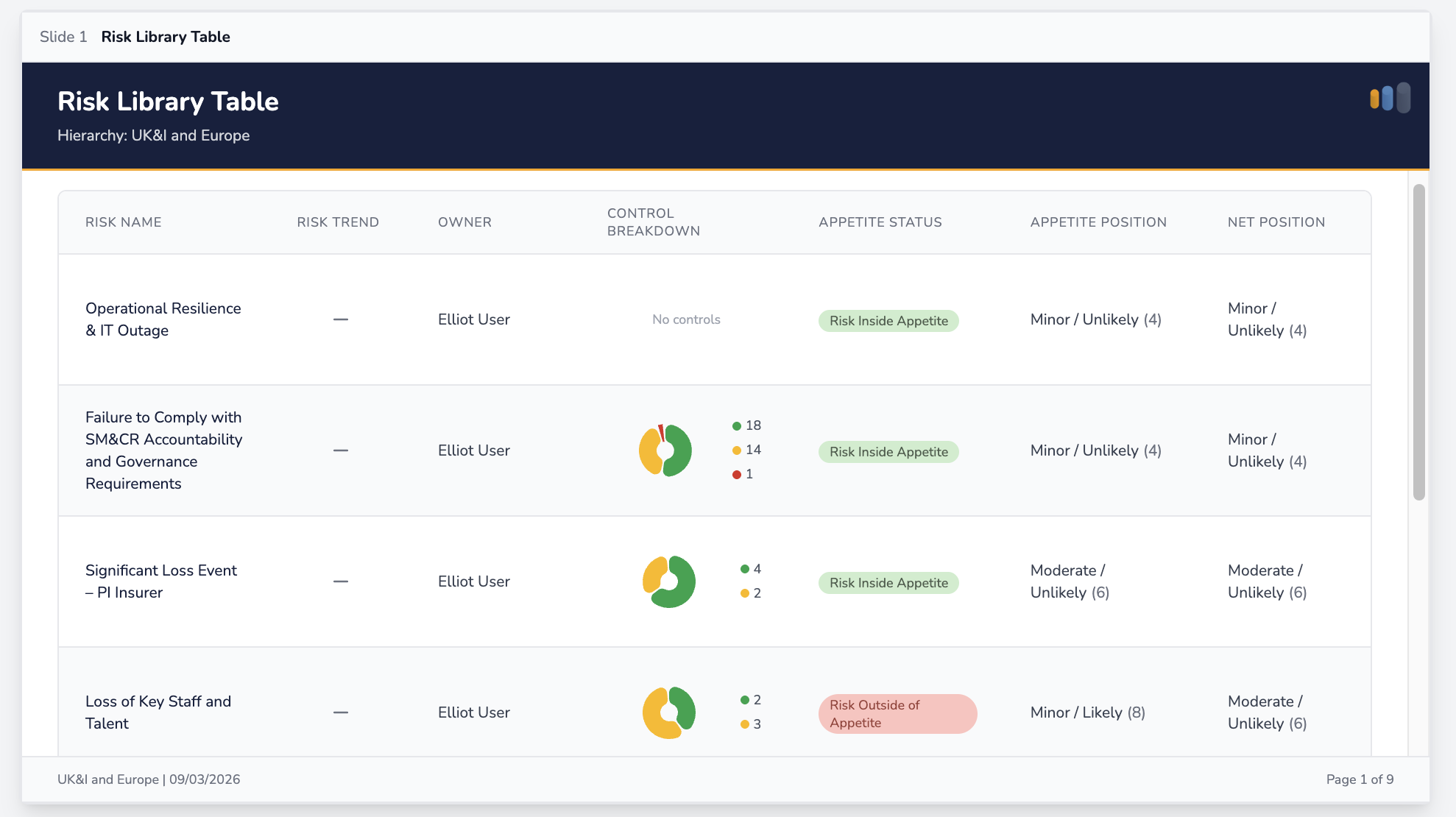
Initia Risk Slide Builder - risk library table (real screenshot)
Risk library table

Building a Recurring Cadence

The word "recurring" is doing a lot of work in how ERM teams describe their board reporting ambitions. In practice, many organisations produce a decent report once and then struggle to maintain quality and consistency as the cycle repeats. The solution is to build the cadence as a process, not a project.

A typical quarterly cadence for a board risk report looks something like this:

  • Week 1 (post-last-board): Distribute update requests to all risk owners. This should be a structured prompt - not a blank email - asking owners to confirm their risk ratings, update action statuses, and flag any emerging concerns.
  • Weeks 2-3: Chase and consolidate responses. The ERM team reviews updates, flags inconsistencies, and challenges any risk ratings that appear stale or misaligned to the current environment.
  • Week 4: Draft the board pack. Write the executive narrative, compile movements, check KRIs, and prepare the top risks section.
  • Week 5: Internal review and sign-off. The CRO or CFO reviews the pack before it goes to the board secretary. Any material additions or changes from this review go back into the draft.
  • Week 6: Submission to board pack. Distributed to directors ahead of the scheduled board or risk committee meeting.

The exact timing will vary by organisation, but the key point is that each step should have a clear owner, a clear output, and a fixed deadline. Without this, the process defaults to a scramble in the final week before the board meeting - which is where quality degrades.

Common Pitfall

The last-minute scramble

A financial services firm's ERM team spends the final three days before each board meeting chasing risk owners for updates, rewriting risk descriptions, and reformatting the pack. The result is always late, always rushed, and always slightly inconsistent with the previous quarter. The fix isn't working harder - it's building the update cadence into the quarter as a structured process, not an afterthought.

Common Mistakes in Board Risk Reporting

Even well-resourced ERM teams fall into predictable traps:

  • Too much detail, not enough narrative: A dense register extract is not a board report. Boards need context and interpretation, not raw data.
  • No comparison to last period: A risk report without movement data gives the board no sense of trajectory. Is the position improving, deteriorating, or stable?
  • Inconsistent format quarter to quarter: If the pack looks different every time, it's harder for the board to quickly orient themselves and find what they need. Consistency signals professionalism and control.
  • Stale risk ratings: Risks that haven't been updated in three or more quarters are a red flag. They suggest ownership is weak and the register isn't being actively managed.
  • No link to strategy: The board is primarily focused on whether risks threaten strategic objectives. A risk report that isn't anchored to strategic priorities will feel disconnected from the conversations the board cares about most.

The Role of Technology in Consistent Board Reporting

One of the most reliable ways to improve the consistency and quality of board risk reporting is to remove as much manual effort as possible from the process. When the report is assembled from spreadsheets, emails, and slide decks, each cycle introduces variability and risk of error.

Modern GRC platforms like Initia change this by making the board pack a near-automatic output of the risk management process:

  • Live dashboards reflect the current state of the risk register at all times, so the board pack starts from accurate, up-to-date data rather than a manual extract.
  • Automated owner prompts go out at scheduled intervals, ensuring the update cadence runs without the ERM team having to chase individually.
  • Movement tracking is built in - so the "what's changed" section writes itself, with risk rating changes logged and attributed automatically.
  • Consistent formatting every cycle, reducing the time spent on presentation and layout and eliminating the version control issues that come with shared documents.

The result is a board report that takes hours to produce rather than days - and that boards can trust to be accurate, current, and comparable to previous periods.

Getting Started

If your current board risk reporting feels inconsistent or stressful to produce, the place to start is not the format - it's the process. Map out how information flows from risk owners to the ERM team to the board pack. Identify where the delays and quality gaps sit. Then build in the structure to address them.

A board that receives a clear, well-structured risk report on a predictable cadence will develop far more confidence in the ERM function - and far more appetite to engage with the risk conversations that matter.

That confidence is ultimately what effective risk governance looks like in practice.

For a deeper look at what boards and regulators expect, see our guide to board-level risk reporting. To understand the risk scoring that feeds into these reports, read how to assess enterprise risk. And when assembling the pack from a register that lives in spreadsheets becomes the bottleneck, our shortlist of the best GRC software for mid-market companies covers what right-sized tools look like.

When you are ready to move from spreadsheets to GRC software, our buyer guide on how to choose a GRC tool covers selection criteria, what to look for in a GRC platform, and the alternatives to legacy enterprise suites for mid-market teams.

See Initia in action

Ready to transform your GRC?

See Initia Risk
in action

An exploratory call to discuss what works and what doesn't, what's still done on Excel, and what you're looking for in a tool.

No commitment required
Understand your needs
Detailed walkthrough
Typical response within 4-6 hours